
why GPT-Live feels different (it’s not a model, it’s the plumbing)
while everyone studied the model. OpenAI was busy rebuilding the plumbing.

[01] the tap
You turn the tap.
Water comes out.
You don’t think about the 4km of pipe underneath your street, the pressure valves, the treatment plant that ran all night so the water reaching your kitchen doesn’t kill you.
You just wanted water for your coffee.
That’s the deal with all invisible infrastructure. It only becomes visible when it breaks.
For years, voice AI broke constantly.
You’d ask it something and there’d be that half-second of dead air where you couldn’t tell if it heard you or just died.
Then GPT-Live shipped, and none of that happened.
[02] it’s not the model
Everyone online is calling GPT-Live magic.
The silences are shorter. It talks over you the way a person would.
It feels less like a chatbot and more like a call.
So naturally, the whole internet did what it always does — it went looking for the model.
- New architecture?
- Bigger context window?
- A smarter training run?
None of it.
OpenAI published the full engineering breakdown this week, and the model itself is almost a footnote in it.
while everyone studied the model, OpenAI was busy rebuilding the plumbing.
[03] the tiny model nobody names
Old voice AI worked like texting out loud.
You speak. ➔ It transcribes. ➔ It waits. ➔ It thinks. ➔ It replies.
Every step is a handoff, and every handoff is latency you can hear.
But the real bottleneck was smaller than any of that.
A tiny model called a turn detector sat quietly in the middle of the pipeline. Its only job: guess when you’ve stopped talking.
Guess early, it cuts you off. Guess late, the whole thing feels sluggish.
All that compute, all that training — and the entire experience of talking to an AI hinged on a model that wasn’t even the main one.
GPT-Live was built to kill that model entirely.
[04] listening and talking at the same time
GPT-Live doesn’t wait for you to finish a sentence.
It listens and speaks in the same breath — what engineers call full-duplex.
This is closer to how humans actually talk. You don’t freeze mid-sentence when someone jumps in. You just adjust, without thinking about it.
Doing that at inference scale, across millions of concurrent audio streams, without anything falling out of sync — that’s not a model problem.
That’s six months of systems engineering.
[05] two models, one conversation
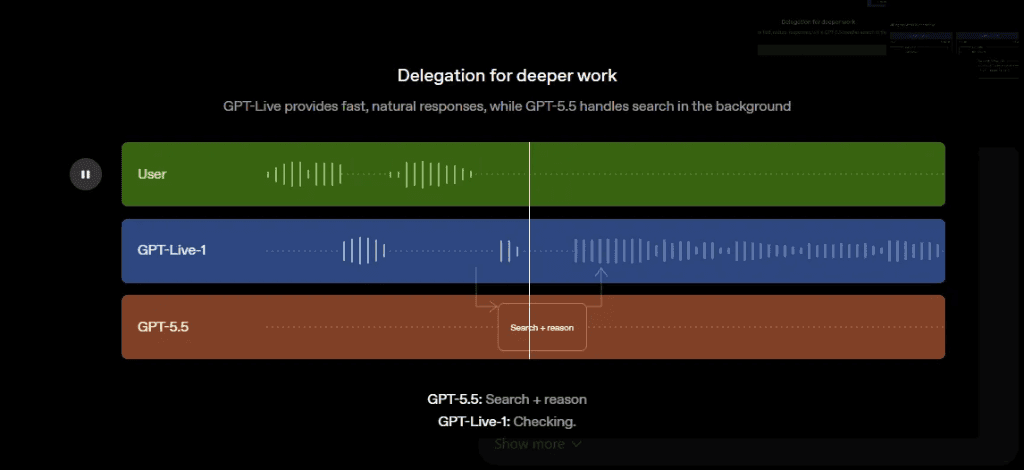
GPT-Live doesn’t carry the whole conversation alone.
When something needs real reasoning, a search, a lookup, a harder question — it quietly hands off to GPT-5.5 in the background. You never hear the handoff happen.
Think of it like a call center.
GPT-Live is the person on the phone with you.
GPT-5.5 is the expert typing answers into their earpiece.
One keeps you talking. The other does the thinking.
Fast responses from GPT-Live, deeper reasoning from GPT-5.5, all happening simultaneously.
[06] the pipe you never see
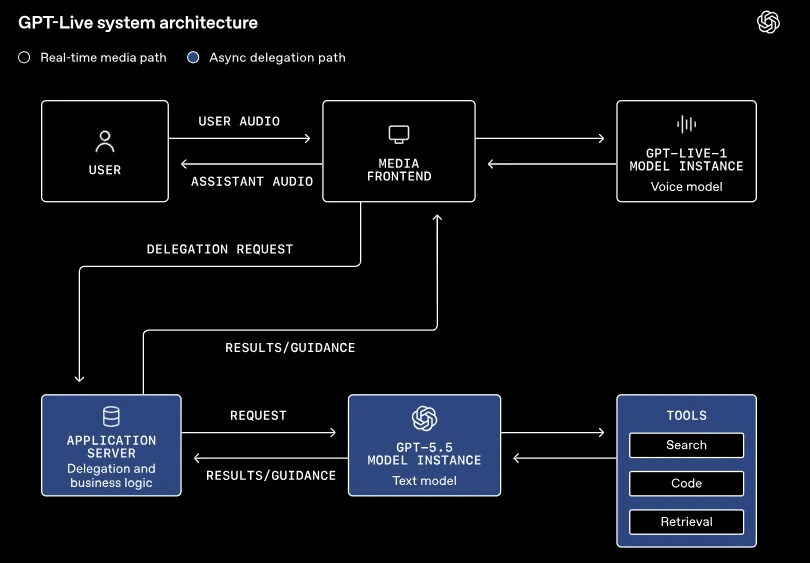
This is the part that convinced me this was a plumbing problem, not a model problem.
OpenAI split the system into two paths that never touch:
Audio in, audio out — fast, continuous, non-negotiable.
Tool calls, database lookups, business logic — allowed to be slow.
A slow database query can never stall your voice. They physically can’t block each other.
They also rewrote the entire audio frontend in Go, replacing the old Python implementation.
The p95 latency on the new system — the slow, unlucky 5% of requests — now matches the p50 of the old one. The worst case became the old median.
[07] WebRTC connection starts
Starting a call used to take six network round trips before you could even speak — a handshake protocol built for a slower internet.
OpenAI built something called WARP to collapse that to one.
Then they pre-negotiated the session before you even click the button, so by the time your first audio packet lands, the server’s already waiting for you.
A redesigned connection pipeline cuts startup latency before the conversation even begins.
[08] the 45-minute problem nobody demos
Long calls have a quiet failure mode.
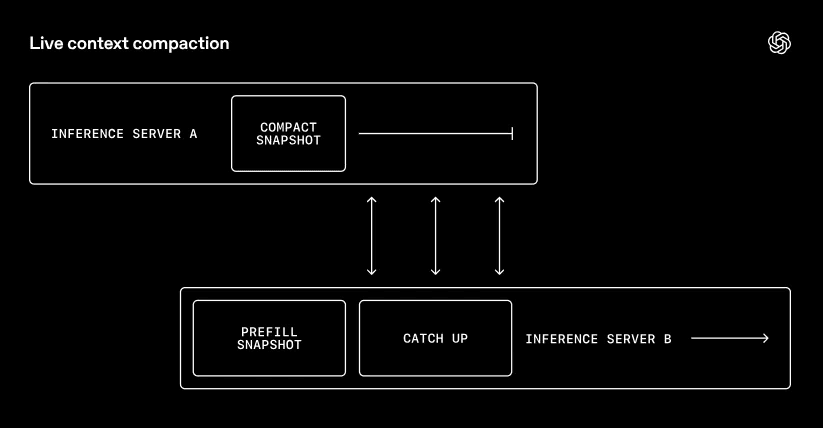
Context keeps growing until the model hits its limit, and normally you’d have to stop, summarize, reload — and the user hears an ugly pause.
GPT-Live handles it with a handoff you’re not supposed to notice. While one model instance keeps talking to you, a second instance gets prepared in the background, already warmed up on a compacted version of the conversation.
When it’s ready, the system switches mid-call. No pause. No silence.
Nobody in a two-minute demo will ever hit this bug. Every real user on a 45-minute call would have.
[09] i built the small version of this problem
I built Saral AI a few weeks back, a multilingual voice receptionist for Indian clinics and MSMEs. We got end-to-end latency from 5.2s to 2.2s, and at the time it felt like the biggest win of the build.
Reading OpenAI’s engineering blog was humbling in a specific way.
Everything they optimized — startup latency, stateful handoffs, keeping the audio path physically separate from the slow path — is the layer most indie builders never even look at.
We’re all still arguing about which LLM to call.
[10] here’s the uncomfortable part
It’s easy to read all this and think:
But that’s not actually the lesson.
The lesson is that the thing separating a demo from a product was never the model. It was whether you were willing to go one layer down into the protocol, the state machine, the thing nobody claps for.
most people won’t go look at the pipes.
that’s why the pipes are still where the edge is.
[11] the plumbing you don’t see
The best engineering disappears.
You don’t compliment your tap for having water pressure. You just drink your coffee.
GPT-Live spent six months building the version of that for conversation — the pipeline nobody will thank them for, because if it’s working, nobody will ever notice it’s there.
The Standard
Not a bigger model.
Better plumbing.
Right now I'm building Orbit, an autonomous AI employee that helps SaaS companies discover and build partnerships. I'll be documenting everything along the way: the wins, the bugs, the pivots, and the late-night builds. (small plug)
Also if you’re building voice AI and you’ve only been thinking about which LLM to call, you’re not behind. You’re just one layer too high.
the plumbing, not the tap, Dhruvil
P.S. if you go read OpenAI’s engineering breakdown and it makes you feel small the way it made me feel small — good. that’s usually the sign you found the actual frontier.
